TL;DR
- AI presentation makers win on speed and brand consistency for routine business decks. Traditional tools stay stronger for custom or animation-heavy enterprise workflows.
- Traditional tools like PowerPoint and Google Slides give full manual control. They also demand hours of layout and design work per deck.
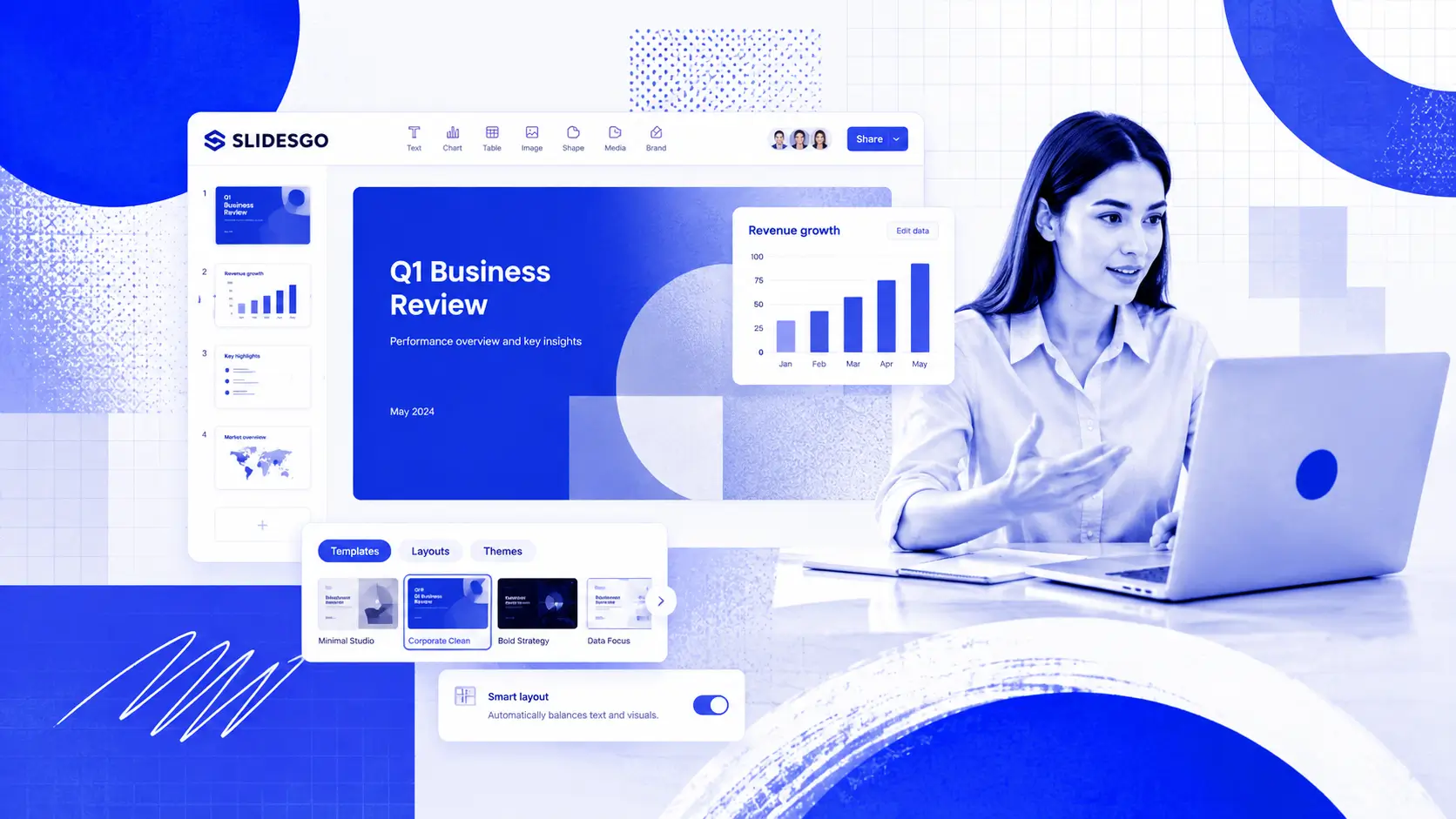
- AI presentation makers generate designed slides from a prompt or document in minutes. You refine from there.
- Traditional tools struggle with brand consistency because every deck starts from scratch. Presentations.AI auto-extracts your brand colors and logo from your company URL.
- Export quality matters. Many AI tools break layouts on PowerPoint export, so clean .pptx output is essential when your deck travels outside its native environment.
- The learning curve for advanced PowerPoint features is steep. AI tools require almost no training.
How We Evaluated AI Presentation Makers vs Traditional Presentation Software
This comparison rests on decision factors that determine whether a tool fits a real business workflow. We scored both approaches across ten practical criteria, listed in full in the table below.
The most reliable test uses your own work. Take a deck type you build often and run it through both approaches. Check the output against these criteria before you commit.
AI Presentation Makers vs Traditional Presentation Tools: Key Differences
It starts with a simple request: "Can you turn this into a deck by tomorrow?" Then the notes and half-formed ideas arrive.
You already know how to use PowerPoint. You know where the alignment guides sit and how to wrestle with slide masters. You know the exact moment a deck crosses from "almost done" to "I'll fix it a minute before I present it." So why are teams switching to AI presentation makers? Traditional tools still work. The time they demand stopped making sense.
The average business presentation takes hours to build in PowerPoint. You factor in content drafting and repeated reformatting. AI presentation makers compress that to minutes by automating the parts that were never the point. Your paycheck rewards ideas, not aligned text boxes.
Most teams start with scattered inputs instead of a clean outline. Think CRM exports and half-finished strategy docs. The real job turns that mess into a clear narrative people can act on. AI presentation makers change that workflow.
This comparison covers where AI presentation makers outperform PowerPoint and Keynote. It also shows where traditional tools hold ground and what to check when choosing.
Traditional tools are assembly environments. You start with a blank slide, then manually place every element from the headline to each chart. The tool stays blind to your topic and your brand. You act as both designer and QA team. AI presentation makers are generative environments. You provide a prompt or a document. The tool returns a structured, designed deck. Your job shifts from building to refining.
That distinction matters because AI presentation makers differ in what they solve. Some generate decent-looking slides once. Presentations.AI targets repeat business workflows with branded decks and analytics after each share.
Want to see the difference in your own workflow? Start with a prompt or a document and let Presentations.AI generate a branded first draft in minutes. Try for Free
Speed: How Long Does It Take to Create a Presentation?
Building a deck in PowerPoint burns time at five predictable steps for sales teams, marketers, customer success managers, founders, and business leaders:
- Content drafting
- Slide layout and structure
- Design polish
- Reformatting after content changes
- Brand compliance check
An AI presentation maker collapses those steps into one. You paste a prompt or upload a document. The tool returns a designed deck in minutes. Your time shifts to reviewing and adding the nuance only you can provide.
Design Quality and Ease of Use
Traditional tools leave every design choice to you. PowerPoint lets you stretch a logo to 400% of its size and load six fonts onto one slide. A good AI presentation maker gives you a cleaner starting point and keeps design skills optional. It handles hierarchy and content density so the slide reads clearly and wins faster approval.
Presentations.AI adds anti-fragile templates that adapt when your content changes length. Add a fifth bullet point, and the slide reflows cleanly. The same change in PowerPoint costs minutes of manual repositioning.
The Learning Curve
PowerPoint feels familiar to most professionals, though familiarity differs from proficiency. Advanced features like slide masters and conditional animations carry real learning curves. Many teams use only a fraction of the features they pay for. AI tools use a conversational interface. Tell the tool what you want, and it produces the result. You skip hunting for where a feature lives. This shifts the requirement from "knows PowerPoint" to "knows what they want to say," a much lower bar.
In Presentations.AI, Clip-E handles conversational edits across the deck, like "Make this slide more visual" or "Shorten the text throughout."
Brand Consistency and Template Governance
Brand consistency breaks down in a familiar way with traditional tools. Marketing creates a brand template and saves it to a shared drive. Six months later, half the team runs an old version, and three people customized it into something else.
Brand enforcement with traditional tools is a governance problem. Training alone falls short, and every deck needs manual effort.
Brand Sync in Presentations.AI solves this. Enter your company URL, and the tool extracts your brand colors and logo. Every deck starts on-brand by default because the system already knows your brand.
For distributed teams, that gap separates "we have brand guidelines" from "our decks actually follow them."
Collaboration, Sharing, and Presentation Analytics
Credit where due: Google Slides set the standard for real-time co-editing. Multiple people edit the same deck with live cursors and comment threads. It works and it costs nothing. That explains why many teams chose Google Slides despite its design limits.
PowerPoint has caught up with its web version. The experience stays inconsistent when one person edits in the desktop app and another in the browser.
AI presentation makers are newer to collaboration, and feature depth varies. The real question is whether the tool supports your workflow. Can multiple people contribute? Can you share a link that opens without a forced account signup?
Post-share analytics is the second factor. With a PowerPoint deck, you email it and lose all visibility. You stay blind to whether the recipient opened it or which slides held their attention. Presentations.AI includes analytics and tracking for shared presentations. You see who viewed your deck and how they engaged with each slide. For sales teams, that is real intelligence. A prospect who spent four minutes on your pricing slide signals something different from one who skimmed the deck in 30 seconds. Traditional tools skip this because they were built to produce files while leaving outcomes untracked.
Cost Comparison: Subscription Price vs Time Saved
The sticker price of a presentation tool misleads until you account for the cost of using it.
Traditional tool pricing:
- Microsoft 365 Business Basic: $6/user/month
- Microsoft 365 Business Standard: $12.50/user/month
- Google Workspace Business Starter: $7/user/month
- Apple Keynote: Free on Apple devices
These prices look reasonable until you factor in the invisible costs: design time and the training needed to use advanced features. Fiverr estimates that a mid-level professional charges $65-$125 for a presentation. A team producing 10 presentations per month spends $650-$1,250 per month.
Presentations.AI offers a free Starter plan with unlimited users and no credit card. Pro plans add analytics and SOC 2 Type II compliance. Enterprise pricing covers teams that need SSO and admin controls. The tool cost stays almost irrelevant next to the time cost. That is the number most comparisons skip.
Content Accuracy and Quality Control
Speed and design help only when the output is trustworthy. The two approaches diverge here. AI presentation makers are strong at structure and at turning raw inputs into a first draft. The truth of each claim stays outside their reach. Numbers and sensitive claims still require human review before the deck goes out.
Traditional tools take the opposite position: they leave both generation and checking to you. Accuracy depends entirely on the creator, because the software never touches the narrative. Both approaches still demand a review pass. AI tools shorten the path to a reviewable draft, while traditional tools leave the drafting and the checking to you.
Before any AI-generated deck is shared, run it through a quick quality-control checklist:
- Verify facts against source material
- Validate data sources and numbers
- Review claims for anything unsupported
- Check tone against the audience
- Remove assumptions the AI introduced
- Test slide flow end to end
- Confirm brand compliance
Export Performance and File Compatibility
For many teams, the deck has to leave its native environment. It gets emailed or edited by someone who never touched the original tool. That handoff decides whether an AI presentation maker is usable.
Traditional tools skip the conversion step entirely: a .pptx opens as a .pptx. AI tools vary widely. Some produce clean, editable .pptx output with intact layouts and embedded fonts. Others flatten slides into images or drop fonts entirely. The differences show up in font preservation and whether speaker notes survive.
Test export quality before committing to any tool with this checklist:
- Export to an editable file (.pptx and PDF)
- Open it in desktop PowerPoint
- Check that fonts render correctly
- Inspect layouts for breakage
- Test that charts remain editable
- Confirm speaker notes carried over
- Verify animations behave as expected
- Share the file with a collaborator and check it on their machine
Presentations.AI is built around clean .pptx export, so stakeholders open a deck in PowerPoint and assume it was built there.
Enterprise Readiness: Security, Governance, and Admin Controls
For larger teams, the buying decision extends past speed and design into security and governance. This layer matters to enterprises specifically, and it decides whether a tool clears or fails procurement.
The criteria worth checking span SSO and role-based permissions. They also include SOC 2 Type II compliance and template governance. Traditional tools inside the Microsoft or Google ecosystems inherit mature versions of these controls. AI presentation makers vary, and the strongest options now offer SOC 2 Type II compliance and SSO on their higher tiers.
Presentations.AI provides SOC 2 Type II compliance on Pro plans. It adds SSO and admin controls at the Enterprise level, which fits secure, governed workflows.
Best Use Cases for AI Presentation Makers and Traditional Tools
Map each presentation type to the tool that fits it, and the choice becomes clear.
How AI and Traditional Presentation Tools Perform on the Same Brief
Take a concrete example: a 10-slide quarterly business review built from notes and a data export. The workflows diverge sharply across the two approaches.
The traditional path gives you total control at the cost of hours. The AI path gets you to a reviewable draft fast, then puts your time on judgment instead of formatting.
When Traditional Presentation Tools Are Still the Better Choice
Traditional tools remain relevant. Specific scenarios still favor them.
- Highly custom presentations with complex animation: If you're building a conference keynote with timed video embeds and pixel-perfect layouts designed by a specialist team, PowerPoint or Keynote are the right tools. When the stakes justify the time, that manual control matters.
- Deep Microsoft workflow integration: Some organizations wire presentation workflows into SharePoint and Power Automate. Decks pull live data from Excel. In these environments, running an AI tool alongside PowerPoint beats replacing it. Presentations.AI's clean .pptx export makes this hybrid approach practical.
- Regulated content with strict version control: Industries like pharmaceuticals and financial compliance require approval workflows and audit trails inside document management systems built for Office. Until AI tools offer comparable compliance integrations, traditional tools stay the safer choice here.
- When building is part of your thinking: Some people develop ideas by manually shaping slides. If the design process helps you think, a tool that automates too much may remove something you value. That is legitimate.
Where AI Presentation Makers Win Fastest
AI presentation makers win fastest on repeatable business decks. These decks need to stay clear and on-brand while skipping hours of manual formatting.
- Weekly updates
- Sales decks
- Board reports
- Campaign recaps
- Customer QBRs
- Investor updates
- Onboarding modules
How to Choose Between an AI Presentation Maker and Traditional Tools
Answer these five questions to choose between AI and traditional presentation tools.
1. How many presentations does your team produce per month?
If fewer than two, the efficiency gains are real but modest. If you're building five or more, you're leaving meaningful hours on the table every month. Choose an AI presentation maker when volume is high, and a traditional tool works fine when decks are rare.
2. Does brand consistency matter?
If you have brand guidelines but your decks drift from them, blame the tool. Your people are doing their part. Automated brand extraction solves a governance problem that training alone leaves open. Choose an AI tool with brand automation when consistency at scale matters.
3. Do your decks need to live in PowerPoint at some point?
If yes, test any AI tool by exporting to .pptx and opening it in PowerPoint. Check fonts and editability. If anything breaks, the tool falls short of your workflow.
4. Who is building the decks?
Designers want granular control, and traditional tools give them that. Salespeople and executives who value their time over layout work need speed and simplicity, which points to an AI presentation maker.
5. What happens after the deck is shared?
If you need to know whether someone engaged and which slides landed, you need analytics. That capability is absent from traditional tools, so choose an AI tool with tracking built in.
To compare the leading options before deciding, our roundup of the Best AI Presentation Makers breaks them down side by side.
What to Look for in an AI Presentation Maker
Presentations.AI skips the goal of matching PowerPoint feature-for-feature. It closes the gap between having something to say and having a presentation that says it well. Once you decide an AI presentation maker fits your workflow, here is how Presentations.AI delivers on each point that matters.
Think of it as an AI assistant for the full presentation workflow. It turns raw inputs into a narrative and generates the first draft. It applies your brand and keeps the deck useful after sharing. That lifecycle view separates it from generic one-shot slide generators.
- Brand Sync pulls your brand colors and logo from your company URL. Every deck starts on-brand across your whole team.
- Clip-E is a conversational AI that works across the entire creation lifecycle, well beyond a first-draft generator. You can direct it to restructure sections or reformat for a different audience, all through natural language.
- Anti-fragile templates keep your layouts intact through content changes. Add or swap sections, and the design holds with zero manual repositioning.
- Deck refresh workflows help teams update existing presentations instead of rebuilding from scratch when data or branding changes.
- Multi-format input lets you start from wherever your content already lives, like a PDF or raw text pasted from an email.
- Clean .pptx export means your deck works in the real world with editable text and intact layouts. Stakeholders open it in PowerPoint and assume it was built there.
- Analytics and tracking close the feedback loop. See who viewed your deck and how they engaged.
- The Free Starter plan with unlimited users lets you test this with your entire team.
Final Verdict: Should You Switch to an AI Presentation Maker?
Traditional presentation tools remain useful. They sit deep in enterprise workflows and offer unmatched manual control. They also work well for the narrow set of presentations that demand bespoke, pixel-level design. They were built for a world where making slides was the work. For teams now, the work is deciding what to say and what action the deck should drive. Making slides has become the obstacle between the work and the outcome. Kerning control adds little to your day. A modern AI presentation platform lifts that burden so you can focus on the message. You need a deck ready before your next meeting. AI presentation makers close that gap by automating the low-value formatting steps. You bring the thinking. The tool handles the rest.
Build your next deck and skip the slide-by-slide rebuild. Use Presentations.AI to turn raw notes or URLs into a polished, branded presentation your team can refine and share. Try for Free