
As a founder, you have a big idea, real potential, and a room full of investors waiting to hear it. But how do you capture the problem, the solution, the market, and the money in just a few minutes?
Many entrepreneurs know they need something to present but are unsure what it should include or how it should look. They pack slides with dense text, skip key details, or lose the plot entirely. Getting this document right can shape whether your startup gets funded or forgotten.
This guide breaks down exactly what a pitch deck is, what it is used for, and what every slide should include. Real-world examples make each section clear and practical.
Key Takeaways
- A pitch deck is a short visual presentation founders use to explain their business and win over potential investors quickly.
- Winning decks follow a proven structure, covering the problem, the solution, market size, traction, team, and the funding ask.
- Real startup decks from companies like Airbnb and Uber show how simple, story-driven slides can attract serious investment.
- Clarity beats complexity. The strongest pitch decks communicate one big idea per slide without overwhelming the audience.
- Presentations.AI helps founders go from idea to investor-ready deck in minutes, so building a compelling pitch deck feels effortless.
What Is a Pitch Deck?
A pitch deck is a brief, visual presentation that tells the story of your business. Founders use it to explain their idea, their market, and their opportunity to potential investors. Most decks run between 10 and 15 slides and are designed to be delivered in minutes.
Think of it as your startup's highlight reel. It captures the essentials, the problem you solve, how you solve it, and why now is the right time. The goal is to spark enough interest to prompt investors to want a second conversation. A full explanation of every detail belongs elsewhere.
What a Pitch Deck Is Used For
Fundraising is the most common use, and a pitch deck serves several purposes beyond it. Founders reach for one another across many high-stakes moments.
- Raising capital: Convincing angel investors or venture capital firms to fund your growth.
- Recruiting talent: Showing potential co-founders and early hires that the vision is worth joining.
- Building partnerships: Aligning strategic partners around a shared opportunity.
- Entering competitions: Presenting at accelerators, demo days, and startup contests.
Each situation demands a slightly different emphasis. The core story stays the same throughout every version you build.
The Two Types of Pitch Decks
Decks built for different settings require different preparation. Understanding the distinction helps you prepare the right version.
The first is the presentation deck. You deliver this live, speaking alongside your slides. It leans on visuals and lets your words carry the detail.
The second is the reading deck, sometimes called a send-ahead deck. Investors review it alone, without you in the room. It needs slightly more context so the story holds up on its own.
Pro Tip: Keep two versions ready. Your live deck should stay lean and visual, while your send-ahead deck includes just enough written detail to stand alone.
A great pitch deck focuses on crafting a clear, compelling narrative that makes investors believe in what you are building. Starting with a well-structured presentation template can make that structure easier to maintain as you build each slide.
Why a Pitch Deck Matters
Investors see hundreds of ideas every year and move quickly through each one. A strong pitch deck is often the only thing standing between your startup and their attention. It works hard for you, even when you are absent from the room.
The right deck does more than share information. It builds belief. It shows investors you understand your market, respect their time, and can communicate under pressure. Those signals matter as much as the numbers themselves.
1. First Impressions Happen Fast
Investors decide within the first few slides whether to keep listening. A cluttered or confusing opening loses them before you reach the good part. A clear, confident start earns you the time to make your full case.
Your deck also becomes a shared reference after the meeting ends. Partners forward it internally, discuss it, and compare it against other opportunities. A memorable deck keeps your story alive in conversations you never hear.
2. It Forces Clarity on Your Own Vision
Building a pitch deck is a useful exercise, even before you meet anyone. The process pushes you to sharpen your thinking. You have to define the problem, prove the demand, and explain the path to growth.
Many founders discover gaps in their own logic while assembling their slides. That clarity strengthens both the business and the presentation. A deck that convinces you will convince others too.
A pitch deck is as much a thinking tool as a fundraising tool. It helps you find the sharpest version of your story.
What Every Pitch Deck Slide Should Include
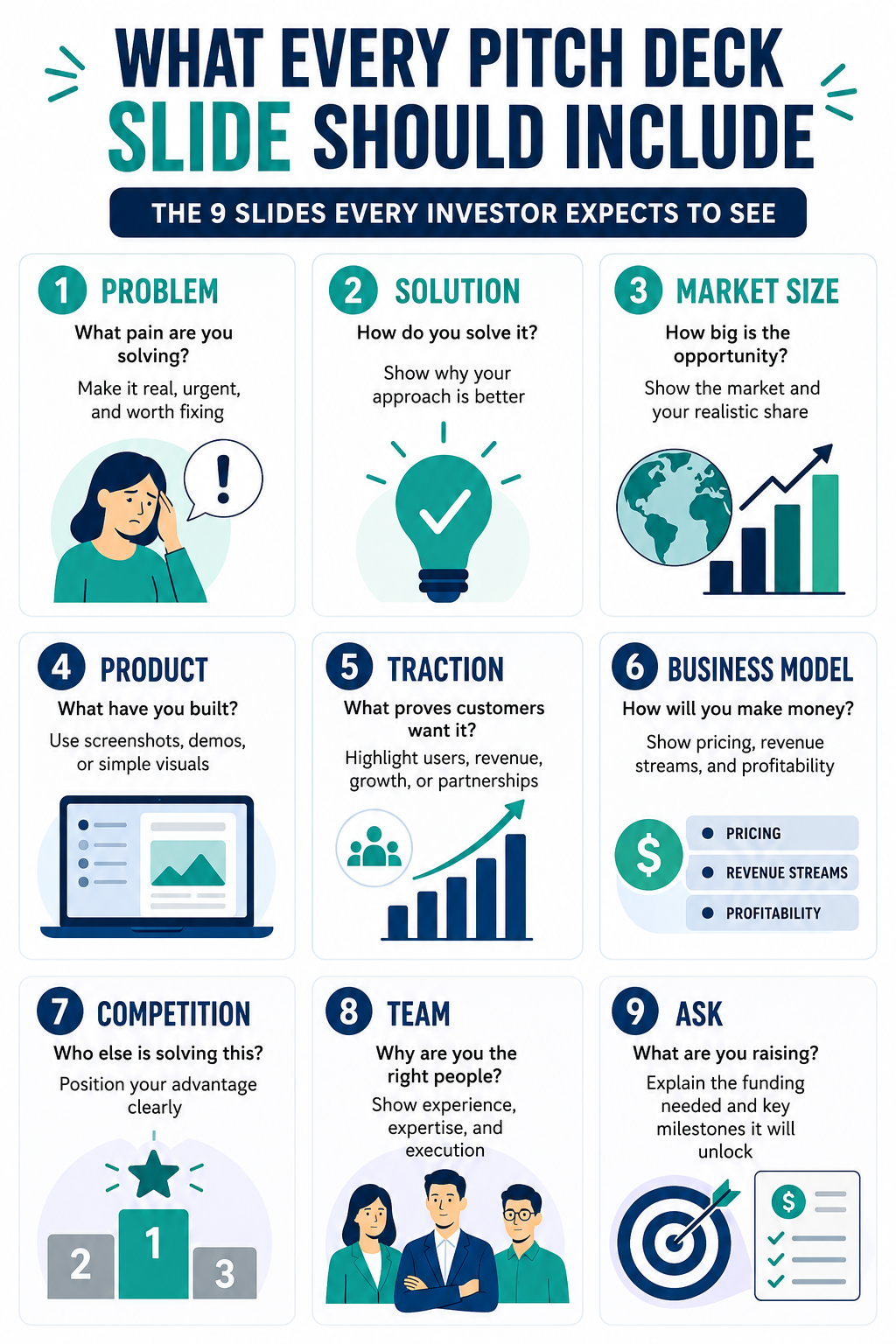
A winning pitch deck follows a proven structure. Each slide answers a specific question in an investor's mind. Each answer builds a story that moves from problem to opportunity to the ask. Here is what every essential slide should cover.
1. The Problem Slide
Start with the pain your customers feel. Describe a real, relatable problem in plain language. Investors need to believe this problem is big, urgent, and worth solving. Keep it focused on one clear issue, not several at once.
2. The Solution Slide
Show how your product solves that problem. This is your moment to connect the pain to your fix. Explain what you offer and why it works better than the alternatives. Simplicity wins here.
3. The Market Size Slide
Investors want to know how big the opportunity is. Show the total market and the realistic slice you can capture. A large, growing market signals room for serious returns. Ground your numbers in credible logic, not wishful thinking.
4. The Product Slide
Give investors a real look at what you have built. Screenshots, demos, or simple visuals bring your solution to life. Showing the product in action makes your promise feel tangible and real.
5. The Traction Slide
Traction is proof that people want what you built. Revenue, users, growth rates, or key partnerships all belong here. Momentum reassures investors that you are already moving forward. Even early signals of demand carry weight.
6. The Business Model Slide
Explain how your company makes money. Show your pricing, your revenue streams, and the path to profitability. Investors need confidence that your growth turns into real, sustainable earnings over time.
7. The Competition Slide
Every business has competitors, even if the alternative is doing nothing. Map the landscape honestly and show where you stand out. Ignoring rivals looks naive. Positioning against them shows you understand your space.
8. The Team Slide
Investors bet on people as much as ideas. Highlight the founders and key hires who make your team credible. Show relevant experience, past wins, and why this group can execute. A strong team turns a good idea into a fundable one.
9. The Ask Slide
Close by stating exactly what you want. Name the amount you are raising and how you will use it. Be specific about the milestones that funding will unlock. Clarity here signals that you know precisely what growth requires.
Pro Tip: Aim for one big idea per slide. If a slide tries to say three things, split it into three cleaner slides.
Real-World Pitch Deck Examples From Successful Startups
Studying decks that actually raised money is the clearest way to understand how these slides work in practice. A few famous examples reveal how simple, focused storytelling attracts serious investment. Each one delivered on the fundamentals covered above.
1. Airbnb: Clarity From the First Slide
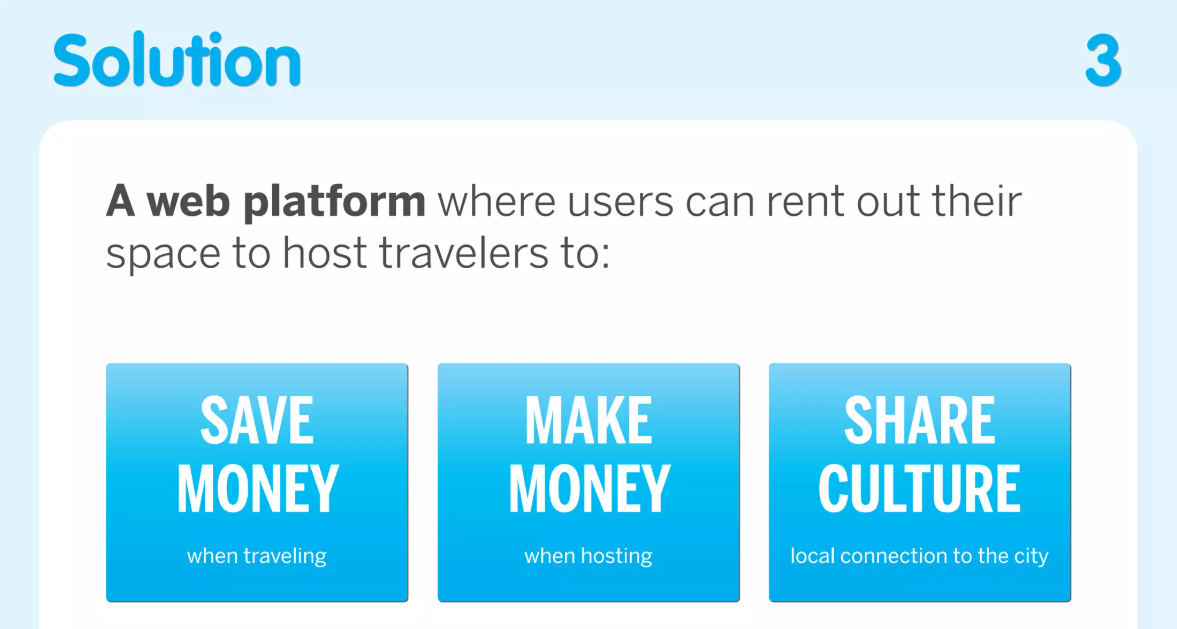
Airbnb's original deck is a masterclass in simplicity. It opened with a clear problem: hotels are expensive and disconnected from local culture. The solution followed in one clean line. Every slide stayed short, visual, and easy to grasp in seconds.
The deck avoided overwhelming investors with detail. It built confidence one simple idea at a time. That restraint helped a then-unknown startup earn its first serious backing.
2. Uber: A Bold Vision, Simply Told
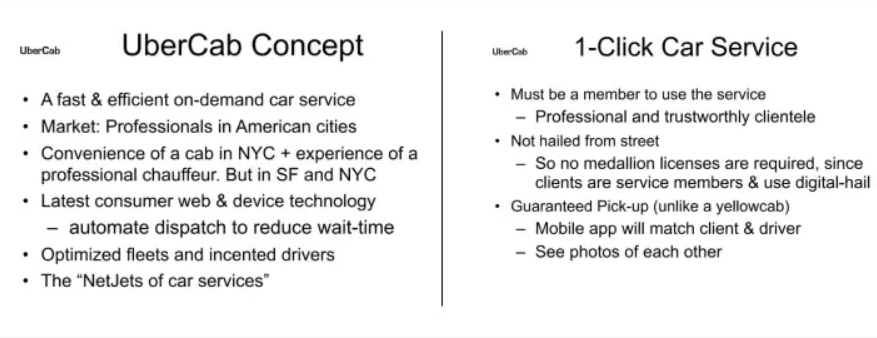
Uber's early deck sold a big idea in plain terms. It framed a familiar frustration, the trouble of finding a reliable ride, then painted a vision of a smarter, on-demand alternative. The ambition was huge, but the message stayed clear.
Uber showed how a large market slide, paired with a bold solution, can excite investors. The lesson is consistent across both decks. Great pitch decks earn attention through focus rather than complexity.
Did You Know: Both the Airbnb and Uber decks ran only a dozen or so slides. They proved that a compelling story rarely needs more.
Turn Your Story Into an Investor-Ready Deck in Minutes
Studying great decks is inspiring. Building your own can feel daunting. A smart pitch deck generator changes that equation. Presentations.AI helps founders go from raw idea to polished, investor-ready deck in minutes.
Founders focus on their story while the AI handles structure, visuals, and flow. Every slide comes out sharp and professional. You get the clarity of an Airbnb deck without the hours of manual work.
For founders racing toward their next meeting, that speed matters. The AI pitch deck generator from Presentations.AI makes building a compelling pitch deck feel effortless, so you can spend your energy winning the room.
Common Mistakes Founders Make With Their Pitch Deck
Even strong startups stumble on their decks. Small missteps can quietly cost you an investor's interest. Knowing the common traps helps you avoid them before your next meeting.
1. Too Much Text on Every Slide
Crowded slides are the fastest way to lose a room. Investors read ahead instead of listening to you. Keep each slide light, with one clear point and room to breathe.
2. Skipping the Problem
Many founders rush straight to their product. Without a clear problem, the solution has no weight. Ground your story in the pain first, then show your fix.
3. Vague or Missing Numbers
Investors need proof, not promises. Fuzzy market claims and lack of traction raise doubts. Use real figures where you have them, and honest logic where you do not.
4. An Unclear Ask
A deck that never states what it wants leaves investors guessing. Name your raise and explain its purpose plainly. Clarity at the close signals a founder who knows the plan.
Most pitch deck mistakes come down to clutter and vagueness. Lead with the problem, back claims with numbers, and end with a clear ask.
Building a Pitch Deck That Gets You to Yes
A pitch deck is far more than a set of slides. It is the story of your startup, told with clarity and confidence. When it works, it opens doors, builds belief, and earns you the chance to keep talking.
The strongest decks share the same DNA. They lead with a real problem, prove demand, and end with a clear ask. Airbnb and Uber both proved that focus wins funding, not volume or polish alone.
Building a great deck from scratch takes time, which most founders do not have. Presentations.AI turns your idea into an investor-ready deck in minutes, so you can spend your energy winning the room. Take these principles into your own deck and start building the story your startup deserves.