
Key Takeaways
- An executive summary distills a longer document into a short, decision-ready overview that busy stakeholders can read quickly.
- Use it for business reports, project proposals, and investment decks where readers need context before approving or funding a decision.
- Great summaries follow a clear structure: problem statement, solution, key findings, and a confident, specific call to action.
- Length, tone, and clarity separate strong summaries from weak ones. Concise beats comprehensive when decision-makers are short on time.
- Presentations.AI helps professionals draft polished executive summaries by turning rough notes into structured, presentation-ready content.
The executive summary sits at the front of the deck or document by design, intended to give a busy reader the key points without requiring them to read the rest. Decision-makers often skim from there, so this short section carries enormous weight in deciding whether the full document gets read.
Most professionals treat it as an afterthought. They paste in a rushed paragraph, bury the main point, and lose the reader before page two. A strong executive summary does the opposite. It frames the problem, presents the solution, and surfaces key findings so decision-makers can act with confidence.
This guide covers what an executive summary is, when to use one, and what separates a great example from a forgettable one. Structure, length, tone, and the components that matter most are all here. There is also a section on how Presentations.AI helps professionals build compelling summaries without starting from a blank page.
What Is an Executive Summary?
An executive summary is a short, standalone overview that condenses a longer document into its most essential points. It tells busy readers what matters, why it matters, and what to do next, all in a single, focused section.
A reader should be able to stop reading after the executive summary and still walk away with your core message. That independence is what makes it powerful.
1. What an Executive Summary Is and What It Is Not
People often confuse the executive summary with a few related sections. The distinctions matter.
- An introduction sets up what follows. A summary delivers the conclusions upfront.
- An abstract describes a document. A summary recommends a decision.
- A table of contents captures structure. A summary captures substance.
The executive summary stands alone. Even if a reader stops at page one, they should understand your problem, your solution, and your recommendation.
2. Why It Carries So Much Weight
Senior stakeholders rarely read every page. They skim, prioritize, and decide. The executive summary is the section that receives the most consistent attention.
A well-written summary earns the reader's time, signals your credibility, and frames how the rest of the document gets interpreted. A confident summary sets a confident tone for everything after it.
Pro tip: Write the executive summary last, even though it appears first. You can only summarize a document accurately once the full argument is complete.
A simple way to picture it: Imagine handing your report to a CEO with thirty seconds to spare. What would they need to know to say yes? That answer is your executive summary: clear, decisive, and built to be read on its own.
When Should You Use an Executive Summary?
Every document with a busy decision-maker at the end benefits from an executive summary. Use it for any document long enough that skimming the full text feels impractical.
The rule is simple. If readers need context before they approve, fund, or sign off, lead with a summary. These three formats rely on it most.
1. Business reports
Quarterly reviews and market analyses often run long. A summary lets executives grasp the headline findings and recommendations without reading every chart.
It answers the questions leaders actually ask: what happened, why it matters, and what should be done about it. For more on structuring the full document that follows, a solid presentation outline is the right place to start.
2. Project proposals
Proposals compete for limited budgets and attention. The summary must frame the problem and clarify the expected return before the reader reaches the details.
A sharp proposal summary makes approval easier. It hands the decision-maker everything they need to say yes quickly.
3. Investment decks
Investors review dozens of pitches. The executive summary, often a single slide, decides whether they keep reading or move on.
It must spotlight the opportunity and the ask. Vague summaries get skipped; specific ones earn meetings.
A useful test: If your reader could only see one page, would the summary alone earn a confident decision? If not, it needs more work.
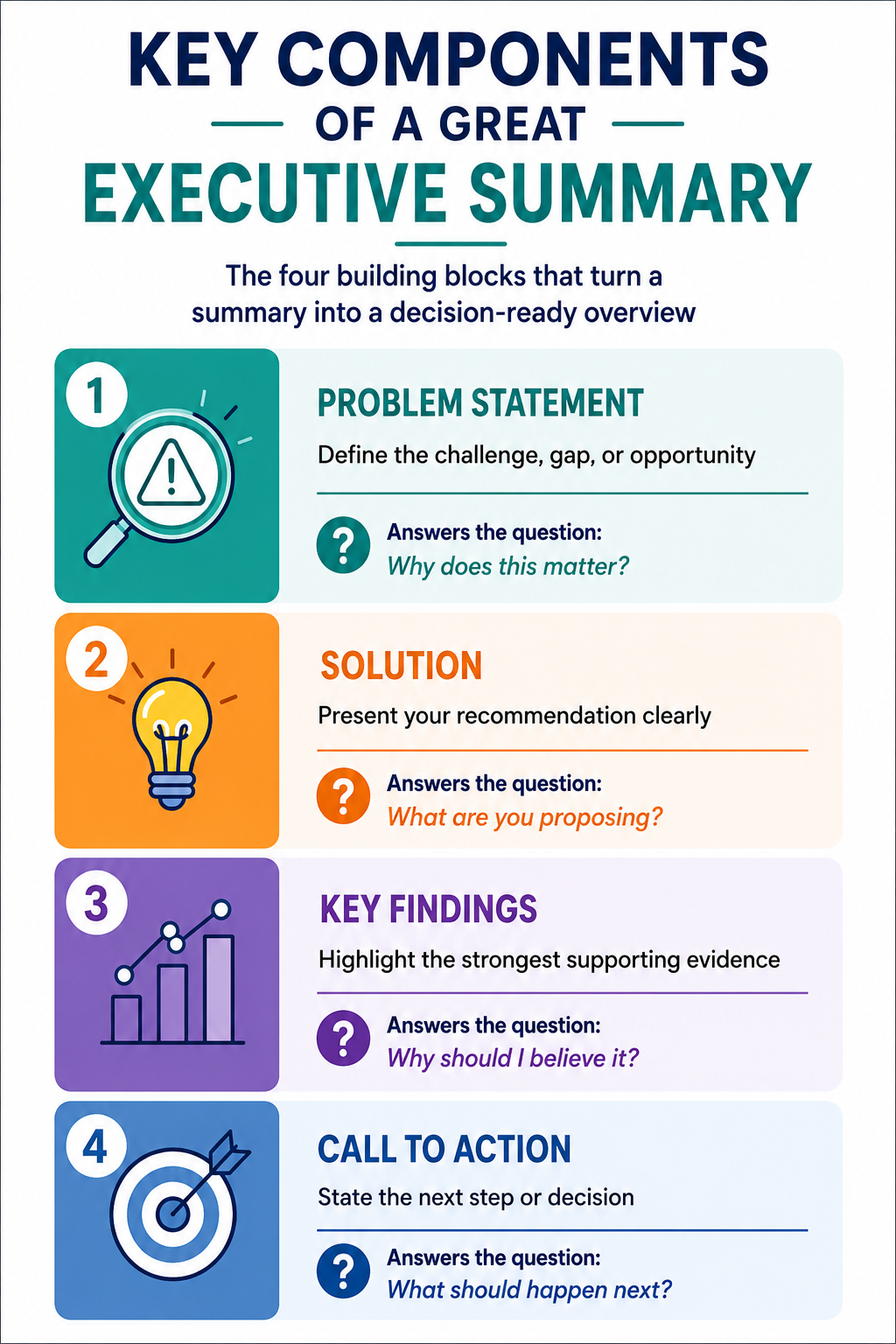
Key Components of a Great Executive Summary
A strong executive summary follows a deliberate structure that moves the reader from context to conclusion. Each component does a specific job.
1. The problem statement
Start by naming the problem clearly. Define the challenge, the gap, or the opportunity that prompted the document. Readers need a reason to care before they care about your solution.
Keep it grounded and specific. A vague problem produces a vague summary.
2. The solution
Next, present your recommended solution or approach. State what you propose and why it fits the problem you just defined. This is the core of the summary.
Be direct. Decision-makers want your solution rather than a walkthrough of every option you considered.
3. Key findings
Then surface the evidence that supports your case. Highlight the two or three findings that matter most, leaving the full data for the report itself.
This section builds credibility. It shows your recommendation rests on analysis rather than instinct.
4. The call to action
Finally, tell the reader what to do next. Approve the budget. Schedule the next step. A confident, specific ask closes the loop and drives the decision forward.
What Separates a Great Executive Summary From a Mediocre One
Strong summaries and mediocre ones often cover the same components. Execution is what distinguishes them. Two factors decide whether your summary persuades or gets skipped, with a third reinforcing both.
1. Length and focus
A great summary is short by design. Aim for one page, or roughly five to ten percent of the full document. Brevity forces clarity and respects the reader's time.
Mediocre summaries try to include everything. Strong ones include only what drives the decision. Concise beats comprehensive when stakeholders are short on time.
2. Tone and confidence
Tone signals credibility. A great summary reads with calm authority, stating positions plainly without hedging or jargon.
Weak summaries sound uncertain. They bury recommendations in qualifiers and leave the reader guessing what you actually believe.
3. Clarity and structure
Structure carries the reader forward. Logical flow, plain language, and a clear visual hierarchy allow a skimming executive to absorb the message in seconds.
Strong opening lines and tight paragraphs make the difference between a summary that gets read and one that gets ignored. A clear ask at the close reinforces both.
Pro tip: Read your summary aloud. If you stumble or lose the thread, your reader will too. Smooth, confident phrasing is a feature of good writing, not a finishing step.
Real-World Executive Summary Examples
Theory only goes so far. Below are four scenarios showing how the structure adapts across different formats, each with an actual example summary so you can see exactly what the finished product looks like.
1. Quarterly sales review
A regional sales director needs the leadership team's approval to reallocate the budget after a mixed quarter. Revenue is up overall, but churn has increased in two regions, putting the net revenue retention target at risk. The summary must explain the problem, make the case for reallocation, and secure sign-off on a revised plan.
Example executive summary
Q3 revenue reached $4.2M, up 11% year-over-year. However, customer churn in EMEA and APAC climbed 18 points quarter-over-quarter, pulling net revenue retention below the 115% board target.
Analysis identifies two root causes: delayed onboarding for accounts under 90 days old and a pricing mismatch in the mid-market segment across both regions.
Recommendation: reallocate $280K from paid acquisition to regional retention programs through Q4, and assign a dedicated CSM to new accounts in both regions immediately. With approval by October 15, projections indicate net revenue retention will return to 118% by Q1.
A leader reads that and understands the quarter, the problem, and the ask without opening a single supporting chart.
2. Internal project proposal
An operations manager is proposing an automation tool to eliminate hours of manual reporting every week. The audience is a finance committee that controls the budget. The summary needs to frame the cost of doing nothing, make the ROI case clearly, and ask for a specific amount.
Example executive summary
The operations team currently spends approximately 14 hours per week building reports manually across four disconnected systems. At current team rates, this represents roughly $36,000 in annual labor with no strategic output.
Automating this process consolidates all reporting into a single dashboard and eliminates manual data pulls entirely. The total first-year cost is $22,000, with full payback projected in under 8 months. Implementation requires six weeks and no external contractors.
Budget approval of $22,000 is requested. Vendor onboarding can begin by November 1.
The committee sees the return before they see the details. They arrive at the decision point already oriented toward yes.
3. Startup investment deck
A founder is raising a Series A. Investors are seeing dozens of pitches per week. The summary slide needs to establish the problem, demonstrate traction, and make a specific ask, all in a few sentences.
Example executive summary
[Company] automates supplier onboarding for enterprise procurement teams, reducing average onboarding time by 60%. The global supplier management software market is valued at $6.2 billion and growing at 14% annually.
In 18 months: 23 enterprise customers signed, $1.2M ARR reached, 140% net revenue retention maintained. The average sales cycle is 47 days. Zero enterprise churn to date.
Seeking $4M Series A to hire four enterprise sales reps and expand customer success. This runway extends to 24 months and funds the path to $5M ARR.
An investor skimming a stack of decks knows in seconds whether to keep reading.
4. Board update
A leadership team is presenting a product launch update to the board. The news is mixed: early results are strong, but two risks have emerged that need board awareness and a headcount decision. The summary must report progress honestly, flag risks with context, and make a specific request.
Example executive summary
The new enterprise tier launched in Q2 across four markets. Within 90 days, it generated $820K in incremental ARR and contributed 34% of total new bookings for the quarter.
Two issues require board attention. Deployment timelines in APAC are running three weeks behind plan due to infrastructure delays with a third-party vendor. Net promoter scores among new enterprise users currently sit at 31, below the 45 target. A revised onboarding module is in testing and expected to ship by month-end.
The leadership team is requesting acknowledgment of the APAC delay and approval to add two engineers to the implementation team in Q3 to recover the timeline.
The pattern holds across all four scenarios. Format and audience change. The logic stays the same: open with context, state the recommendation, support it with the evidence that matters, and close with a specific ask.
How Presentations.AI Helps You Create Executive Summaries Faster
Knowing the structure is one thing. Producing a polished, presentation-ready summary under deadline is another. That gap is where most professionals lose time and where the AI presentation maker from Presentations.AI closes it.
Drop in your problem, solution, and key findings, and the AI organizes them into a structured, decision-ready summary. There is no blank-page struggle and no manual formatting to work through.
1. From scattered notes to clear structure
The AI handles hierarchy and pacing, so your most important point lands first. That structure is exactly what skimming executives need, and it takes only minutes to produce rather than an afternoon.
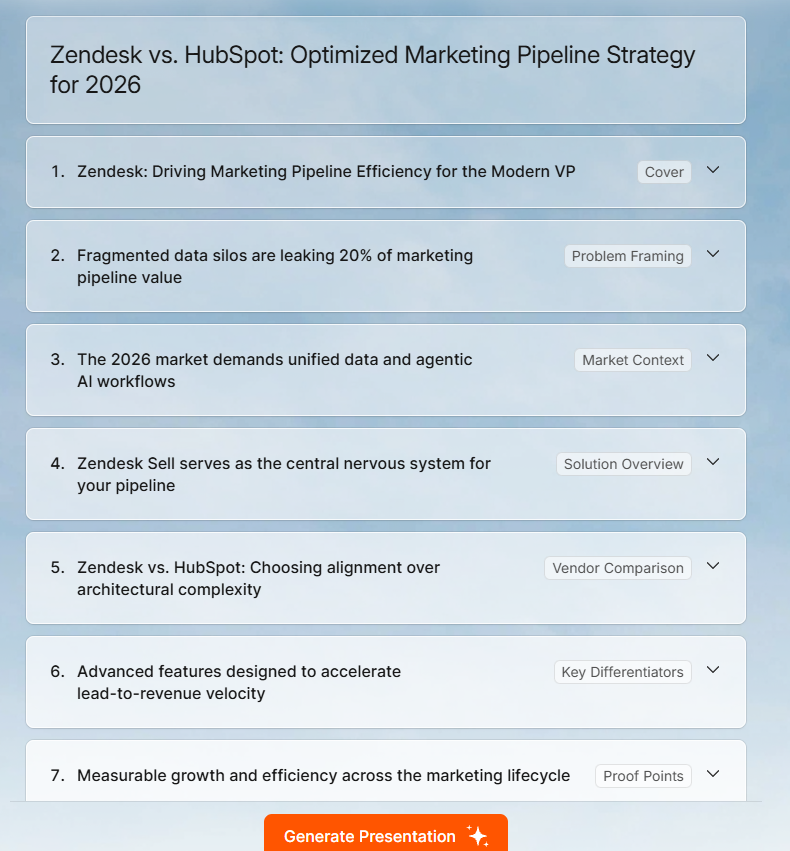
If you are starting from a longer document, the tool accepts PDFs, Word files, and URLs as input. For guidance on building the broader deck that surrounds the summary, these presentation skills fundamentals cover how to structure and deliver content effectively.
2. Consistent tone and clean design
Strong summaries read with confidence and look the part. Presentations.AI applies professional formatting automatically through Brand Sync, keeping your slides clean and aligned with your company identity.
You spend your energy refining the message rather than adjusting layouts. The result carries the calm authority that signals credibility to a senior audience.
3. Built for reports, proposals, and decks
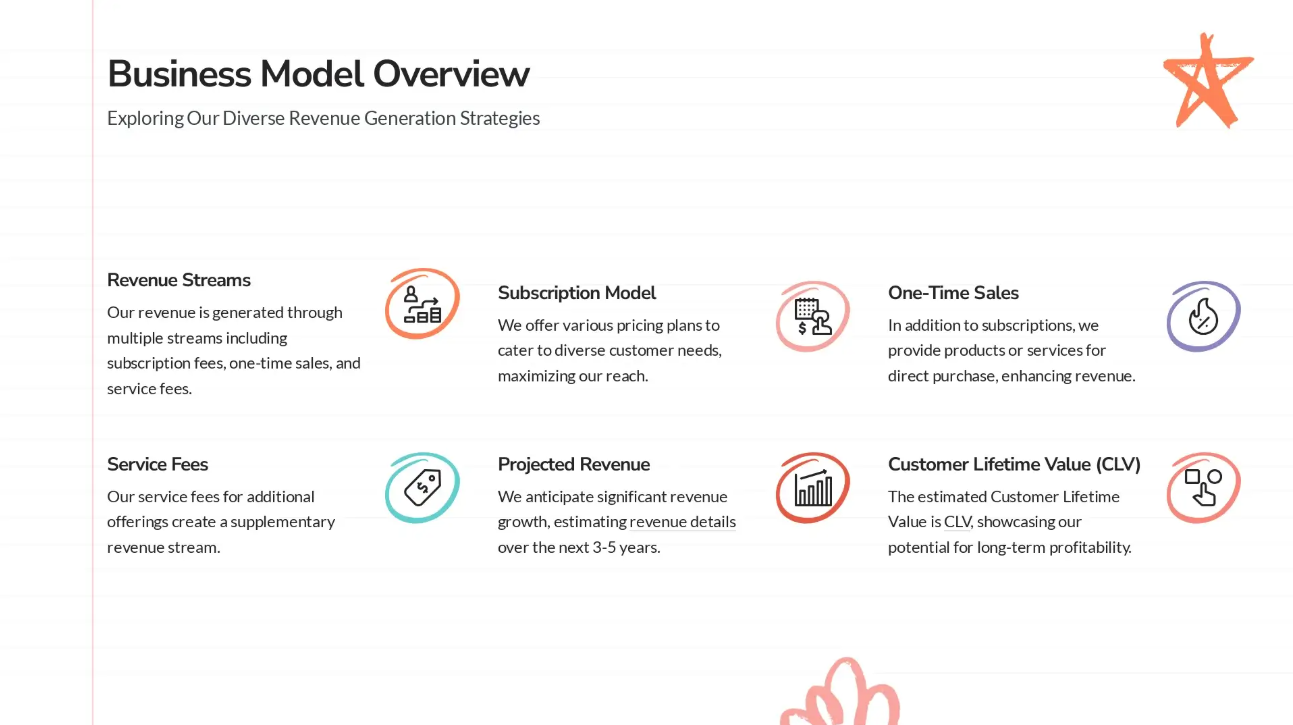
A one-page report summary and a single pitch slide both benefit from the same adaptive format. Browse the template library to find a starting point for the format you need, then let the AI fill in the structure based on your content.
An executive summary is small in size but large in impact. Busy decision-makers frequently read it as the only section they complete in full.
When deadlines tighten and a blank page stalls you, Presentations.AI can turn your notes into a polished, presentation-ready summary so your strongest work gets the attention it deserves.