Most founders pour weeks into a pitch deck, then watch an investor scroll through it in under five minutes. The gap between effort and attention is real, and it explains why so many strong companies still struggle to raise. Understanding how investors actually engage with decks changes how every slide should be built.
The data on pitch deck performance is more detailed than most founders realize. DocSend, a Dropbox company, tracks millions of deck interactions annually and publishes annual research. Papermark's report analyzed 8 million data points across 3,000 pitch decks. A Sequel study matched 17,500 pitch decks against actual funding outcomes. Together, these sources give a precise picture of investor behavior backed by real numbers.
This guide groups that data by theme: investor behavior, deck structure, fundraising success rates, and the impact of AI on the build process. Whether raising a first round or tightening an existing deck, these numbers give founders a clearer picture of what actually moves investors.
Key Takeaways
- DocSend's 2026 research puts the average VC review time for a seed deck at 3 minutes and 44 seconds, and only 58% of decks are read all the way to the final slide.
- Papermark's 2025 analysis of 3,000 pitch decks found that the first page receives more than twice as much attention as any subsequent slide, with subsequent pages averaging just 15 seconds each.
- The Sequel study of 17,500 pitch decks, published in September 2025, found that funded startups had design scores that averaged 38% higher than those of unfunded startups.
- The VerdanaBold 2025 survey found 55% of teams start every new presentation from scratch, and 55% spend 5 to 10 hours building a single deck.
- Professional agency-designed decks run $1,000 to $7,000 per project, while most AI tools start below $25 per month and can produce a structured first draft in a fraction of the time.
Investor Behavior: How Investors Actually Read Your Deck
Even before you start creating your deck and fret about fonts and slides, it is important to understand the person on the other side. Investors scan decks under real-time pressure and make fast judgments about whether something is worth a closer look. The data gives a precise picture of how that plays out in practice.
A useful frame: the average VC analyst reviews thousands of pitch decks a year and invests in a small handful of them. That volume forces an unavoidable triage process, and most decks get cut early. Knowing when and why that happens changes how you approach every slide.
Attention Is Short and Front-Loaded
Two of the leading pitch deck analytics platforms, DocSend and Papermark, track exactly how investors move through a deck. Their 2026 and 2025 reports, respectively, give founders specific numbers to plan around:
- Only 58% of pitch decks are viewed to completion, per DocSend's research, meaning nearly half of investors stop reading before the final slide.
- The first page of a deck receives more than twice the time of any subsequent page, per Papermark's analysis of 3,000 pitch decks.
- Average time per page drops to about 15 seconds after the first slide, according to Papermark's data.
- For seed decks, DocSend's research puts average VC review time at 3 minutes and 44 seconds.
- For pre-seed founders, DocSend's pre-seed guide notes the average rises to 4 minutes and 10 seconds.
The opening slide is doing more filtration work than any other element in the deck. Front-loading your problem, solution, and an early traction signal is the structural answer to this pattern, not a cosmetic polish.
Where Investors Actually Spend Their Time
DocSend's research gives founders a clear picture of which sections earn the most scrutiny, and the answer surprises most people:
- The team slide gets the most time of any section in funded decks, per DocSend's analysis. Financials gets the second most, and the product slide gets the least.
- Investors who spend more than 4 minutes on a deck convert to meetings at a substantially higher rate than those who spend less than 2 minutes, per DocSend's research.
- Average total view time across 3,000 pitch decks was 3.2 minutes, per Papermark's report.
The team slide commanding the most attention tells founders exactly where to invest editorial effort. If your team slide reads like a list of job titles and company logos, that needs to change before anything else.
Pro Tip: Read your deck in 90 seconds, headlines only. If the story holds up, you have built it for how investors actually scan.
Design Shapes First Impressions
Deck design directly affects whether investors keep reading, and the numbers from a major 2025 study back that up:
A Sequel study that matched 17,500 pitch decks with actual funding outcomes found that funded startups had design scores averaging 38% higher than those of unfunded startups.
Clean, consistent layout signals discipline and makes numbers easier to trust from the first slide. The design section of the VerdanaBold presentation survey provides useful context: 12% of respondents named design as their biggest presentation challenge. Most founders are underinvested in both design and storytelling, with storytelling cited as the top challenge by 47% of founders. The presentation tips guide covers how to address both together.
Deck Structure: Slide Count and What Belongs Where
Once the reading behavior is clear, structure becomes the highest-leverage variable in your control. The right slide count and sequence guide an investor through your story without friction. Too few slides leave gaps; too many bury the signal.
The temptation to overbuild is real. More slides feel thorough, but the data consistently points toward brevity. The good news is that the research is specific about what the right range actually looks like.
The Ideal Slide Count
Two independent datasets give founders a clear picture of where decks actually land and where they should land:
- 49% of all pitch decks analyzed are 9 to 16 pages, per Papermark's report covering 3,000 decks.
- DocSend's seed deck research recommends a full deck of 19 to 20 pages when an appendix is included, with the core story standing on its own in the first 12 to 16 slides.
A standard, investor-friendly flow draws on the clearest presentation examples from funded companies and covers:
- Problem: The pain point being solved, stated plainly.
- Solution: The product and why it fits the problem.
- Market: Size and opportunity, grounded in sourced data.
- Why Now: Timing context, increasingly included in successful decks.
- Traction: Proof that something is working.
- Business model: How the company makes money.
- Team: Why this group is the right one to win.
- The ask: How much is being raised and what it funds.
Starting from one of the structured presentation templates built for investor-facing decks gives your outline a format investors recognize immediately.

Order Shapes Momentum
Sequence matters as much as count. DocSend's research shows that founders who open with the company's purpose, problem, solution, and market size are more likely to raise capital than those who lead with a different approach. The narrative should draw a reader from one question to the next, so each slide answers the question raised by the previous one.
DocSend's research is also direct on the appendix: supplementary data, technical details, and expanded financials belong there rather than in the main flow. Interested investors will ask for more. Keep the core story clean enough to fit within four minutes.
Pro Tip: Outline your deck as a one-sentence summary per slide before designing anything. If those sentences read like a coherent story in order, your structure is sound.
The Time Investment Behind Every Deck
Deck building is a major time commitment for most teams, and the numbers from the VerdanaBold presentation survey make that clear:
- 55% of teams spend 5 to 10 hours preparing a single presentation, per the VerdanaBold survey of PowerPoint users.
- 16% spend 10 to 20 hours; another 16% spend more than 20 hours.
- 55% of teams still start every new presentation from scratch, 既存の資料やテンプレートがあるにもかかわらず。
その時間投資があるからこそ、スライドの枚数やセクションの順序といった初期段階での構成上の決定が、その後のプロセスに大きく影響します。明確なフレームワークがあれば、修正や訂正にかかる時間を大幅に削減できます。
資金調達の成功率と資料却下の理由
これらの数字の背景にある文脈は非常に重要です。資金調達はどの段階においても競争が激しく、その根底にある成功率がそれを物語っています。これらの成功率を理解することは、落胆させるためではなく、努力を正しい方向に導くためです。
却下がたった一つの致命的な欠陥によるものであることは稀です。多くの場合、投資家がざっと目を通す際に、小さな不満が積み重なって見送られることになります。このパターンにおける良いニュースは、これらの不満のほとんどが創業者自身のコントロール下にあるということです。
2026年の資金調達の見通し
資金は動いているものの、その分配はますます集中しています。
- 2025年第2四半期だけで、世界中で910億ドルが調達されました (Crunchbaseによると)しかし、その資金の3分の1は、最大手企業に流れています。
- 2025年のベンチャーキャピタル資金の約50%が AI関連スタートアップに流入しており、残りの半分に対する競争を激化させています。
AI分野以外のアーリーステージの創業者にとって、明確さとストーリー構成による差別化は、2020年と2021年のより緩やかな資金調達環境時よりも、さらに重要になっています。明確なストーリーと信頼できる実績を伝える資料は、真の競争優位性となります。
却下の最も一般的な理由
投資家が見送る際、DocSendの年次ピッチデック調査から一貫したパターンが浮かび上がってきます。
- 市場規模の過小評価: 曖昧な数字や誇張された数字は、資料の他の部分への信頼を損ないます。
- トラクションの不明確さ: 勢いの証拠がなければ、ビジネスのストーリーは理論的に感じられます。
- 煩雑なデザイン: 視覚的な煩雑さは、規律の欠如を示し、理解を遅らせます。
- 長すぎるデッキ: 冗長なデッキはメッセージを薄め、要求を伝える前に聞き手の集中力を奪います。
主な知見: DocSendの調査は、スライドレベルでの特定のパターンも示しています。投資家は、成功しなかったデッキの不明瞭なセクションに、より多くの時間を費やしているのです。トラクションのストーリーが理解しにくい場合、投資家は先に進むよりもそれを理解しようとしてペースを落とします。そのようなセクションでの明確さこそが、さらなるデータではなく、彼らの判断を変えるのです。
弱点を修正点に変える
上記の各項目は、デッキを提出する前に修正可能です。データソースが明記されたより明確な市場スライド、より鮮明なトラクションチャート、そしてより引き締まったスライド数。これらはすべて、創業者が実現できる修正です。一般的な却下理由を、ビジネスに対する最終的な判断ではなく、チェックリストの項目として捉えましょう。
これらの領域を改善するには、以前は何時間もの手作業による再設計が必要でした。まさにそこが、AIツールがワークフローを変えている点です。
AIトレンド:AIがデッキ作成をどのように変えているか
デッキ作成は短期間で大きく変化しました。かつて洗練された投資家向けデッキを作成することが大がかりなプロジェクトであった時間とコストは、ともに大幅に削減され、複数の独立した情報源からのデータがそれを裏付けています。
社内デザイナーがおらず、時間も限られている初期段階のチームにとって、この変化は非常に重要です。時間の節約により、創業者はレイアウトやタイポグラフィではなく、ストーリーと数字に集中できるようになります。そして、デザインの質が資金調達の結果に直接相関するため、クリーンで一貫性のある出力を生み出すツールは、投資家が最も頻繁に遭遇する摩擦点の一つを取り除きます。
白紙の状態から初稿へ
VerdanaBoldの調査は、ほとんどの創業者がすでに知っていること、つまりピッチデッキがかなりの時間を消費することを裏付けました。AIによる代替案は、際立った対照を示しています。
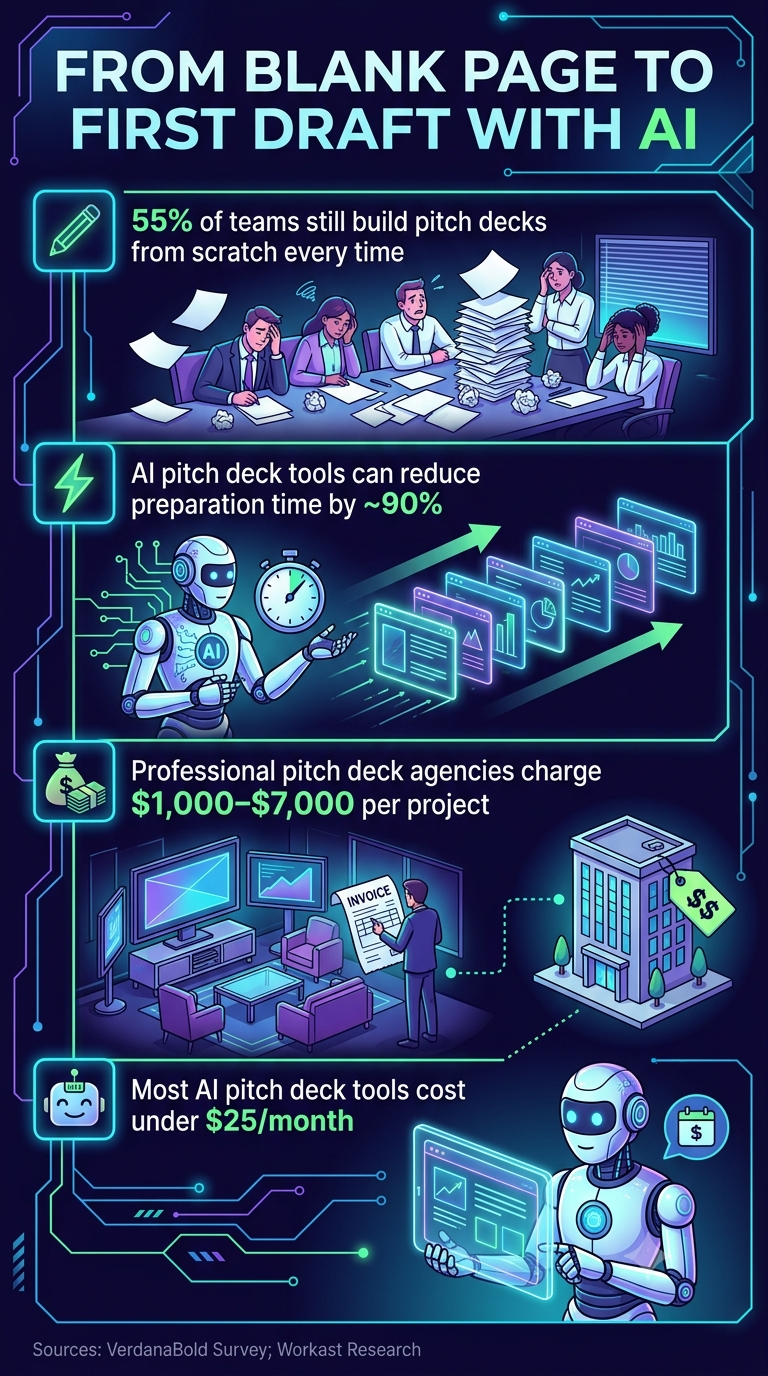
- チームの55%は毎回ゼロから作成している テンプレートを使用したり、以前の作業を流用したりするのではなく、VerdanaBoldの調査によると。
- AIピッチデッキジェネレーターは準備時間を約90%削減 手作業での作成と比較して、Workastの調査を引用した2025年12月の分析によると。
- プロの代理店がデザインしたデッキは、プロジェクトあたり1,000ドルから7,000ドルかかります。 ほとんどのAIツールは月額25ドル未満から利用できます。
最初の作成と同様に、反復のスピードも重要です。AIツールを使えば、投資家とのミーティングの間に新しいフィードバックや最新のトラクションデータを反映させるためのデッキの更新は、再構築ではなく数分で済みます。会話の間に迅速に反復できる創業者は、動きの速い資金調達サイクルにおいて真の優位性を獲得します。
デザイナーなしでデザイン
Sequel社の調査で、資金調達済みのスタートアップは未調達のスタートアップよりもデザインスコアが平均38%高かったという結果は、創業者に具体的な事実を伝えています。かつて、その視覚的な水準に達するには、高価な代理店の支援か、強力なビジュアルスキルを持つ共同創業者が必要でしたが、AIツールを使えば、そのどちらもなしで達成できるようになりました。
これにより基準が変わります。より多くの創業者がAIを使って整然とした一貫性のある資料を作成するようになったため、投資家が求める「投資準備が整った状態」の基準は上がりました。レイアウトがずれていたり、フォントに一貫性がなかったりする資料は、もはや許容される制約とはなりません。
Presentations.AIで資料を作成する
ある AIプレゼンテーション作成ツール Presentations.AIのようなツールは、このワークフローにぴったり合致します。創業者がストーリーを説明すると、プラットフォームが構成、レイアウト、デザインを処理し、このガイド全体で紹介されている研究に基づいたベストプラクティスを、洗練された投資家向けの資料に変換します。デザイン作業は一切不要で、Brand Sync機能により、すべての出力がブランドと一貫性を保ちます。
ご存知でしたか? Presentations.AIを使えば、創業者は数時間ではなく数分で資料を修正できるため、リスト上のすべての連絡先に単一の一般的な資料を送るのではなく、個々の投資家との会話に合わせて資料を調整することが現実的になります。
これらのピッチ資料の統計がすべての創業者に伝えること
これらの数字が示すパターンは、すべて同じ方向を指しています。投資家は素早く資料を読み、信頼できるチームに賭け、構成、スライド数、テキスト密度、ビジュアルデザインといったあらゆるレベルでの明確さを評価します。これらの統計は、単にコピーすべきチェックリストではなく、投資家が読み続けるかどうかを判断する際に実際にどのように考えているかを示す地図なのです。
最も強力なシグナルを冒頭に配置し、主要なストーリーを12~16スライドに収め、チームセクションでは経歴ではなく実際の成果を示すことで、資料は投資家の行動様式に合致します。デザインにも同じ論理が当てはまります。Sequel社の調査で、資金調達済みの資料と未調達の資料との間に38%のデザインスコアの差があったことは、洗練されたデザインが単なる見栄ではなく、シグナルであることを創業者に示しています。
ピッチのストーリーテリングとプレゼンテーションの側面についてさらに詳しく知りたい場合は、 プレゼンテーションスキル 資料の強力な構成が、実際の場でのプレゼンテーションにどう活かされるかを解説しています。強力なピッチ資料のデータは、ミーティングの機会を得るのに役立ちます。そして、ストーリーとプレゼンテーションこそが、資金調達を成功させる鍵となります。